


An information page for anyone who would like to know more about the prints,
the variations, the print process, and the thinking behind my preferred
choices too.
Print formats
The print process
Print life expectancy
Silver Gelatin prints compared with
C-Type and Giclee prints
Changing papers for numbered prints in
May 2024

Print formats.
Prints currently exist in a number of different formats which can be categorised
as:
Poster prints
Exhibition prints
Bespoke prints
Numbered prints (applies to all images listed in the Print
Archive).
Poster prints are very affordable high quality prints
on coated paper which look great framed. However, they are not archival,
but this is reflected in the price.
Exhibition prints are typically one-off prints made specifically
for exhibiting purposes. Although print quality must be suitably high,
these prints are not necessarily made using archival paper and could be
on a variety of media.
Bespoke prints are made to the specific requirements
of the buyer.
Numbered prints are created to exacting standards and
should be regarded as the preferred print media. Each print is of exhibition
quality, strictly limited in number, and all are signed. They are made
with longevity in mind by using methods
and materials with a proven history of archivability when properly
cared for.
Most of the photographs in the Print
Archive have an aspect ratio of 3:2 so they are printed in a range
of dimensions to suit framing (with a protective border of matting) to
the popular A1, A2, A3, and A4 sizes, which accomodate the 3:2 aspect
ratio well. The few images of a different aspect ratio (such as 4:3 or
1:1) are generally similarly sized, but with dimension differences better
suited to imperial measurement frames.
For ease of reference the numbered print sizes are named as follows:
Gallery size.
The 'gallery' size prints are the largest of the numbered print sizes,
with an image typically 30" x 20" (762mm x 508mm). Usually only
one of these prints will be made.
Original size.
The 'original' size prints are smaller than the gallery print size, typically
20" x 13.33" (508mm x 339mm), and usually no more than three
of these will be made.
Standard size.
The 'standard' size prints are smaller than an original print size, typically
13.5" x 9" (343mm x 229mm), and usually no more than five of
these will be made.
Collection size.
The 'collection' size prints are the smallest, typically 7.5" x 5"
(191mm x 127mm) and they are more numerously available. Usually no more
than 10 of these will be made.


Image of a signed collection size print,
and also shown displayed.
All numbered prints are sold unmounted and unframed. A Certificate of
Authenticity is included, which can be checked with a filed copy if requested.
The print process.
Prior to May 2024, all numbered prints were made by a C-type
or Giclee process.
Prints created from May 2024 onwards are pure silver gelatin prints made
in the traditional way where the image is projected onto light sensitive
black and white paper which is then processed in chemical baths to develop
and fix the resulting image, before being thoroughly washed and dried.
Each print is inspected by myself (and spotted if necessary), then signed
and numbered using archival pigment ink to match the longevity of the
printed image.
The paper I currently prefer is a resin coated silver gelatin paper from
Harman / Ilford with a lustre texture for a semi matt finish. It is an
evolution of the Ilfospeed paper I used to print with in my darkroom over
30 years ago.
I have prints I made then that look just the same today and I trust contemporary
papers and processing to also create prints that can last at least as
well.
Incidentally, fibre based silver gelatin prints can also be made as a
bespoke print.
Print life expectancy.
There is a direct correlation between the life expectancy of the print
and how well it is protected from factors that may cause it to deteriorate.
Such factors are exposure to heat, moisture, atmospheric pollutants, and
light. All can be equally damaging.
In my experience I would protect a print for display by framing it behind
UV light-filtered glass or acrylic. To prevent the print from touching
the glass or acrylic, it should have a window cut mat border. This should
be hinged with acid free tape to mat backing board onto which the print
can be held in place with acid free photo corners. The mountboard used
for the matting border and backing should also be acid free. The frame
backing can then be attached and sealed with paper tape.
This process should provide a good level of protection from atmospheric
pollutants, and depending on the glass or acrylic used, from upto 99%
of UV light, but proper consideration to where the print will be displayed
is a key factor in a long print life. Keeping prints away from direct
sunlight is important. LED light sources are less harmful than flourescent
lights. Damp, or humid conditions should also be avoided, as should displaying
a print near a direct heat source such as above a radiator.
Assuming such protective precautions are taken, I expect a displayed numbered
print to age well over a lifetime and longer, with C-type and Silver Gelatin
prints gradually showing a subtle shift towards the look of old photographs
from the last century and earlier as they head closer towards antiquity.
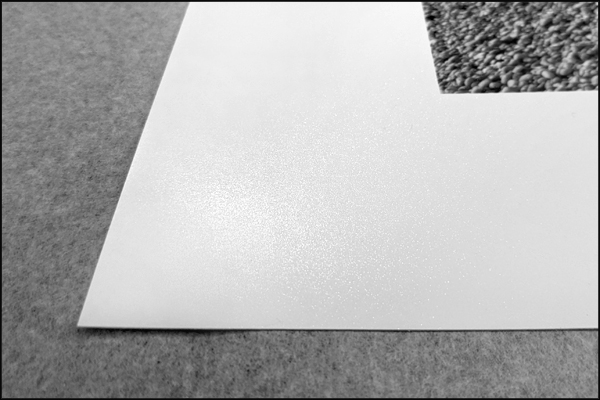
Close view to show the texture of the
resin coated silver gelatin paper used for numbered prints.
Silver Gelatin prints compared with C-Type and Giclee prints.
C-Type prints are also known as chromogenic prints and are similar in
many ways to silver gelatin black and white prints, being made by projecting
the image onto light sensitive paper which is then developed and fixed
chemically. The difference is that the chromogenic prints are made using
a dye based paper designed for making colour images, whereas silver gelatin
paper can only make black and white images.
Fujifilm make one of the most widely used papers for creating chromogenic
prints, under the Crystal Archive label. This paper was used for all Collection
size images made before May 2024. Like the resin coated silver gelatin
prints now available, these C-type prints are expected to last a lifetime
and more if properly cared for.

Close view to show the texture of the
Fujifilm Crystal Archive paper used for C-type prints.
The Giclee process is not a photographic one, instead using sophisticated
inkjet printers and pigment inks to make archival fine art prints. Its
popularity has greatly increased as technological advances have improved
paper archivability and ink permanence. Depending on the ink and paper
used Giclee prints are thought to be able to last many hundreds of years.
This process was used to make all numbered prints before May 2024 that
were larger than Collection size.
Prints were made onto Hahnemuhle Photo Rag 308gsm, a 100% cotton paper
of museum quality for high age resistance. This was my preferred printing
method, as the paper is heavier and has no reflective qualities, the blacks
are deep and the paper base tone has a warmer look. I also felt the paper's
texture complimented the natural grain of my film images and added a random
beauty to digital photographs.

Close view to show the texture of the
Hahnemuhle Photo Rag paper used for giclee prints.
Both print types are standard processes which can be seen in the best
museums and galleries the world over. Despite the lower archive life expectancy
many of the world's most expensive selling photographs at auction were
chromogenic prints.
Changing papers for numbered prints in May 2024
Although there are surely many benefits to C-type and Giclee printing
processes, there are downsides too, and I had started to feel that a pure
black and white print process with traditional techniques would better
reflect my photography practice.
By adopting Silver Gelatin prints as my preferred print media I no longer
needed to be concerned about the possibility of colour casts in C-type
prints. It also addressed an issue I have with Giclee prints, that they
are not so easy to care for.
With Giclee prints I find that one has to be very careful to not touch
the image at all, especially if the print is dark with a lot of black
ink. A small speck of dust can be tricky to remove, and can't always just
be wiped off like it can with a cotton gloved hand on a resin coated print.
It is easier to mark or stain some Giclee prints.
Any moisture can ruin the print completely. This is not such an issue
with C-type or Silver Gelatin prints, both of which are created using
wet chemicals and washed.
I have also found that some of my Giclee prints, made on Hahnemuhle Photo
Rag, were sometimes susceptible to yellowing when they were stored in
less than perfect conditions. C-type and resin coated silver gelatin prints
stored for the same time with the giclee prints in the same box were not
affected in the slightest.
This was important to know for me as I think it is likely that even the
best cared for print will be exposed to less than perfect conditions on
occasion through its lifetime. I have no doubt that there will be another
paper less affected by such conditions but until I have personal long
term experience of this I cannot be fully confident using it.
I have therefore come to the opinion that although Giclee prints have
a technically greater potential archive life, in reality I think the prints
I have are more likely to be damaged before then just by handling by non-professionals
and life in the real world.
This real world handling is also why I prefer printing with resin coated
paper for the numbered prints, rather than with the fibre based version,
as the resin coated prints resist wear and tear from handling particularly
well.
Despite my comments about C-type and Giclee prints I still think they
are a good product and I am happy to make those remaining available to
buy. However, for the reasons stated, all numbered prints made from May
2024 onwards will now be of the Silver Gelatin variety on a resin coated
paper with a semi-matt lustre surface texture.
© GREIG CLIFFORD.
ALL IMAGES ARE SUBJECT TO COPYRIGHT LAWS.
ALL RIGHTS RESERVED.
Cookies